
(Minghui.org) Chinese painting has a history of over 2,000 years, and it is closely related to Chinese calligraphy. The latter reached its peak in the Jin Dynasty, while Chinese painting flourished in the Tang Dynasty. Despite their long history, the core essence of both art forms remains the same.
“In the realm of painting, the most important is the use of water and ink. Following the way of nature, it embodies the gifted power of creativity,” wrote Wang Wei, a Chinese musician, painter, and poet in the Tang Dynasty.
Chinese painting is often referred to as dan qing. Dan is cinnabar (red) and qing is azurite (azure). Because of its vibrant and resistant-to-fading colors, danqing was used in ancient times to record achievements (dan) and historical events (qing). As a result, historians often use danqing as a metaphor for someone whose outstanding contributions are forever etched in history. That is, the meaning of danqing extends far beyond art itself.
The Connection Between Chinese Painting, Ritual, and Music
Until the Qin and Han dynasties, color was related to ritual and music. Painting and color matching followed strict etiquette regulations, preventing artisans from expressing themselves at will. As craftsmen, they meticulously carved auspicious celestial symbols and mythical beast patterns on silk, stone, and roof tiles.
In Han Dynasty murals, silk paintings, and stone carvings, images of deities such as the Queen Mother of the West, the King Father of the East, winged immortals, and the Azure Dragon and White Tiger appear frequently. According to Han Wudi Neizhuan (The Inner Biography of Emperor Wu of Han), the Queen Mother of the West imparted cultivation scriptures to Emperor Wu of Han. She also gave him the True Form Diagram of the Five Sacred Mountains which was passed down through generations.
Among the stone carvings displayed in the Xi’an Stele Forest is the True Form Diagram of the Five Sacred Mountains. This demonstrates that the Han Dynasty society’s deep belief in and reverence for immortality was widespread. Through enduring colors and rigorous painting regulations, the ancients vividly captured their spiritual pursuit of ascension to immortality and a return to their true nature, leaving a lasting visual memory.
Migration in the Jin Dynasty
During the Jin Dynasty (266-420 AD), Chinese painting emerged from ritualistic culture as an independent art form. This change occurred for profound social and cultural reasons.
The northern forces from the non-Han ethnicities invaded Jin’s capital city of Luoyang in 311, killing the crown prince, ministers, and a total of over 30,000 civilians. Sima Rui then established the Jin Dynasty in 317 at Jiankang (today’s Nanjing) which is often referred to as Eastern Jin (while the previous one in Luoyang was called Western Jin).
Until then, the capital cities of different dynasties were primarily located in northern China, with both the Qin and Han capitals situated in what is now Shaanxi Province. Regions south of Yangtze River were generally considered uncivilized and a “wild and pestilential land.” Historian Sima Qian described the area as “a vast land but sparsely populated. People eat rice and fish soup, and some practice slash-and-burn agriculture and water weeding.”
To ensure their survival, the northern gentry—including the top elites, literati, and powerful clans— led large-scale migrations to the south during the establishment of the Eastern Jin, an event known as the Southern Migration of the Gentry. This migration formally propelled northern China’s ritual and music civilization southward.
Having personally experienced the pain of a broken homeland and the unprecedented suffering and contemplation, northern immigrants found inspiration in the beautiful mountains, trees, and rivers in their new place. This also created a new spiritual home for these northern literati who had lost their material homes.
Calligraphy and Painting Share the Same Origin
The first artistic brilliance in Chinese history was born against this backdrop. In fact, calligraphy and painting are generally believed to share a common origin, meaning they were born together. Wang Xizhi, the most famous calligrapher in Chinese history, thus emerged in Eastern Jin Dynasty.
Wang is renowned for his “Lantingji Xu” (Orchid Pavilion Preface) composed in 353, which is widely celebrated as the finest example of running script (xingshu) in history. Born in 303, Wang knew his uncle Wang Yan had been crushed to death by the invading non-Han ethnic forces when he was eight, and his father was also lost in battle, never to be heard from again. After moving south with the rest of his family in 313, he focused on calligraphy and found solace in the southern scenery.
“What once brought delight has, in the brief span of a moment, already become a thing of the past; yet one cannot help but be deeply moved by the memory. Moreover, the span of life—whether long or short—is governed by nature, and all must ultimately come to an end. As the ancients wrote, ‘Death and life are indeed momentous events.’ How can one not grieve?” reflected Wang in “Lantingji Xu,” which was his profound realization after those life events.
Zong Bing, a painter from the Northern and Southern Dynasties born in 375, admired Wang’s lifestyle, and also found solace in nature. For over thirty years, he traveled through mountains and rivers, indifferent to fame and fortune. Zong was highly accomplished in the study of spiritual cultivation. In “On the Enlightenment of Buddhism,” he explicitly proposed insights such as “The spirit is immortal, one can achieve Buddhahood.” As an artist he wrote “Preface to Painting Landscapes” which became the pioneering work in the theory of Chinese landscape painting.
“Now, when a silk scroll is stretched out for distant reflection, the shapes of Kunlun and Lang can be contained within a square inch,” he wrote in the article. “A vertical stroke of three inches may represent a height of thousands of yards; a horizontal stroke of several feet could embody a distance of a hundred miles.”
Kunlun and Lang are huge mountains said to be where numerous deities reside. In the article, Zong also mentioned the Yellow Emperor, Guang Chengzi, Dawei and other figures who were ancient sages or Taoist deities. This indicates that Chinese landscape painting is deeply connected to the divine culture of Chinese civilization.
Landscape Painting in the Tang Dynasty
The essence of landscape painting was revealed in the Tang Dynasty. Sima Chengzhen was both a Taoist and a painter. According to the Taiping Guangji (Extensive Records of the Taiping Era), Emperor Xuanzong of Tang summoned Sima Chengzhen to Chang’an several times, treating him with great respect and keeping him in the inner palace to consult him on matters of cultivation. Sima spoke cryptically, and Xuanzong did not reveal these teachings to outsiders.
Later, Emperor Xuanzong commissioned the Yangtai Palace for Sima on Mount Wangwu, which would become a renowned cultural center during the Tang Dynasty. Here, Sima wrote books and practiced Taoism, stating that immortality is not shrouded in mystery but is achievable through cultivation. Xie Ziran, a woman from Shu (modern-day Sichuan Province), followed him in learning Taoism and, according to official records, ultimately ascended to heaven in broad daylight—an event unique in history.
In The Map of Heaven and Earth Palaces, Sima specifically marked the locations of Taoist cultivation grottoes, which are unable to be seen by ordinary people. Only cultivators could enter these places, because they actually exist in other dimensions. Ancient China was often referred to as Shen Zhou (land of the divine), which indeed corresponds to its geographical environment. In fact, famous mountains and great rivers all have their origins—they may appear to be ordinary on the surface; but in reality, there are other unseen grottoes in other dimensions.
Sima and renowned poet Li Bai had a long-standing friendship. This in turn fostered connections among Meng Haoran, Wang Wei, He Zhizhang, Chen Zi’ang, Song Zhiwen, and others, who were collectively known as the Ten Friends of the Immortal Sect at Yangtai Palace on Mount Wangwu. Sima also left a massive landscape mural at Yangtai Palace. Historically recorded as sixteen feet high and ninety-five feet long, the mural depicted mountain streams, hills, floating clouds, and cranes, exuding a magnificent grandeur. After viewing it, Li wrote a poem to praise the artwork, which was also Li’s only surviving calligraphy.
The landscape paintings at Yangtai Palace brought the previously distant and mysterious places of deities to life, making it concrete and real, with clouds, pines, green mountains, and clear waters. Sima’s theories and creations on landscape painting directly influenced the aesthetics of an entire generation of literati during the Tang Dynasty, becoming a wellspring of wisdom for the widespread popularity of Tang Dynasty landscape poetry and painting. Painters favored by Emperor Xuanzong of Tang, such as Wu Daozi and Li Zhaodao, were both deeply influenced by Sima’s views on landscape painting.
Before the Tang Dynasty, landscape paintings were mostly used as backgrounds for figure stories. One example is Gu Kaizhi’s “Nymph of the Luo River” from the Eastern Jin Dynasty, where mountains were smaller than figures, and the landscape was merely an embellishment for the figures. In contrast, Sima infused landscapes with the Taoist worldview of blessed lands and tranquility. On the other hand, poets like Li Bai and Wang Wei transformed this into poetry, making landscapes no longer just cold stones, but spiritual carriers full of vitality, breath, and life. Landscape paintings were thus imbued with spirituality.
From then on, Chinese landscape paintings depicted mountains as large and figures as small, with landscapes as a projection and connection of the vast universe onto the human world. Humans were portrayed as lost beings in the mundane world, yearning for elevation, and a return to purity.
Convergence of Music, Painting, and Poetry
Wang Wei, a legendary figure of the Tang Dynasty excelled as a poet, painter, and musician. The renowned scholar Su Shi, once commented that one could see a landscape in Wang’s poetry while appreciating poetry within his paintings. Beyond his literary and artistic talents, Wang also served as the Assistant Director of the Imperial Music Academy.
Here is an example of what Wang brought us:Bird Chirping Stream
In relaxation I saw the flower falls,in the quiet mountain where the world stalls;The rising moon woke up a bird from dream,chirping from time to time over the spring stream.
Wang is often considered as the progenitor of Chinese painting. “In the realm of painting, the most important is the use of water and ink. Following the way of nature, it embodies the gifted power of creativity,” he wrote. “Unroll a painting—be it vast or compact—and it captures landscapes spanning hundreds or even thousands of miles. The cardinal directions appear vividly before one's eyes, while the changing seasons of the year come to life beneath the brush.”
According to a legend in the Song Dynasty, scholar Qin Guan once suffered from gastrointestinal problems. A friend showed him Wang’s famous painting, “Wangchuan Villa.” After looking at it for several days, Qin felt as if he had truly entered a lush valley, breathing in the refreshing air. As a result, his internal organs seemed to have been cleansed, and his mood improved greatly; his gastrointestinal problems were cured without medicine.
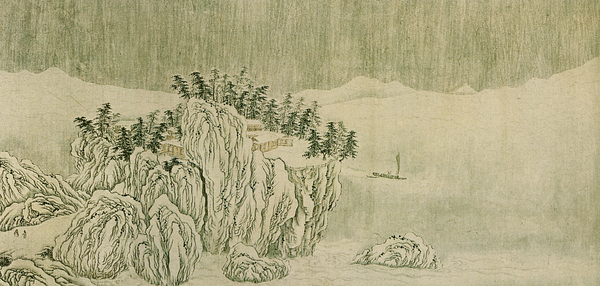 Snow-covered Yangtze River (detail), by Wang Wei
Since the Tang Dynasty, landscape painting served as “portable scenery” in the lives of the ancients. Until the Song, Yuan, Ming and Qing Dynasties, Chinese landscape painting continued uninterrupted. Hanging a tranquil scroll painting in the hall allowed individuals to "walk, look, live and travel" within the painting to escape their burdens of worldly affairs.
Like a clear, otherworldly stream, a landscape painting could gently flow through the hearts of countless scholars or those with spiritual pursuit. The secular world of today is decadent, but mountains and rivers remain pure. In the face of setbacks in one’s career and social unrest, a landscape painting hanging in one’s home may serve as a sanctuary for the soul. The thatched cottage in the painting, or the humble hermit sitting alone by the mountain stream, could be the embodiment of one’s inner world. That is, a three-foot-long landscape painting is like a one-square-meter monastery.
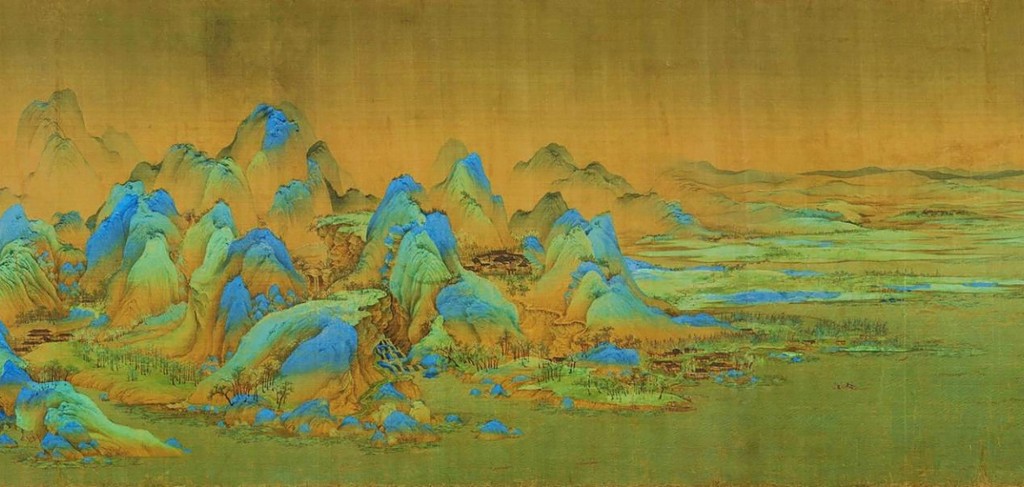 Painting: A Panorama of Rivers and Mountains (partial view), by Wang Ximeng (Song Dynasty)
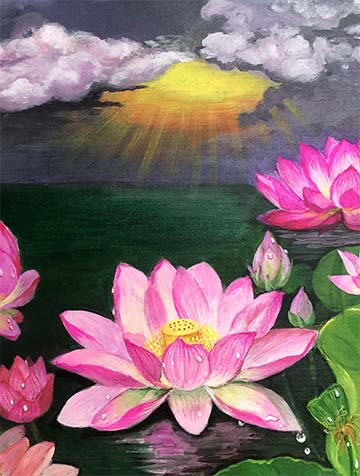
As painters, these artists remained uninvolved in ideologies or power struggles, allowing them to express eternity through landscapes and convey their feelings through painting on a piece of Xuan paper. After the Song Dynasty when Chinese painting became more secular, people enjoyed life and playful explorations of the world. Flowers, birds, fish, and insect paintings became popular. Yet landscape paintings, like pure lotus flowers rising above the mundane have continued to embody transcendence, and have been cherished through the ages.
Harmony between Humanity and Nature
By the Ming and Qing dynasties, the level of social morality had changed significantly compared to the Han and Tang dynasties. People’s reverence for deities had become utilitarian and superficial. However, the concept of the divine did not disappear from their spiritual world. In folk traditions, it was transformed into auspicious patterns, celestial maps, and symbols of fortune, prosperity, longevity, and happiness. Landscape paintings were also incorporated into this auspicious culture. Porcelain, furniture, fans, New Year pictures, architectural sculptures, clothing embroidery, and so on—a green mountain, a long pavilion, a few wild geese flying—were all firmly established in daily life, invisibly influencing people's aesthetic concepts.
Even during the Cultural Revolution, such harmony between man and nature were not completely erased. For example, in the revolutionary model opera “Shajiabang,” a scene features an eight-immortal table and a purple clay teapot in the center of the stage; both representing traditional Chinese culture. Even the blue-printed cloth worn by the protagonist, Sister Aqing, retains the most authentic traditional symbols of the southern folk culture.
Traditional Chinese culture possesses a resilience, flowing like water without form, and profound sound without noise. The concept of “harmony between heaven and humanity" is a central theme throughout. But what is heaven? Can humans ascend to heaven? In Han Wu Nei Zhuan (The Inner Biography of Emperor Wu of Han), Emperor Wu consulted the Queen Mother of the West and other deities on how to ascend to heaven.
Citing Bao Pu Zi by Ge Hong, the Queen Mother of the West said,“It is not attaining immortality that is difficult, but hearing the Way;It is not hearing the Way that is difficult, but putting it into practice;It is not the practice itself that is difficult, but follow it through to the end.”
When the time is right, the rich historical foundation of Chinese landscape painting and its many symbolic elements emerge like seeds planted in our souls. Amid the midst of fame and fortune, these gentle streams of traditional Chinese culture constantly awaken the good thoughts in our hearts, and gently guide us along the right path.
Copyright © 1999-2026 Minghui.org. All rights reserved.
Category: Traditional Culture